Friday, March 25, 2016

The Importance of Intimate Love

“Husbands, love your wives, even as Christ also loved the church, and gave himself for it. . . .  So ought men to love their wives as their own bodies. He that loveth his wife loveth himself,” (Eph. 5:23-25, 28)

I have talked extensively about the importance of the emotional intimacy between couples in this blog. There is another facet in a marriage that is just as important, that is the physical intimacy between a man and a woman which occurs after they are married. The problem many young people of the Latter-day Saint faith face is the lack of true knowledge as to where to find the answers regarding marital matters. We are admonished to seek knowledge from “the best books” and that we ought to “teach one another words of wisdom” (see Doctrine and Covenants 88:118).

This is to include physical intimacy. Heavenly Father intended us to be thus so:
“God said to man, ‘Be fruitful, and multiply, and replenish the earth, and subdue it: and have dominion over the fish of the sea, and over the fowl of the air and over every living thing that moveth upon the Earth.’ (Genesis 1:28) Well, he has planted, in accordance with this, a natural desire in women towards man, and in man towards women and a feeling of affection, regard, and sympathy exists between the sexes” (John Taylor, Gospel Kingdom, 61).

There are questions one would probably ask, such as: Is satisfaction reached the same way for both men and women? How often should a couple be together? What is appropriate or not appropriate in terms of sexual expression? And so on (Brotherson). Obviously it is difficult to answer these delicate questions, as each relationship is different and each married couple will find they have their own way of expressing intimate love for one another.

It is perfectly okay to ask questions, do not be afraid to ask, there are wonderful Latter-day Saint books out there with excellent answers. Do not be shy about picking them up, you might just find the answer you are looking for. Although it has been said that marriage is the school of love, and it is certain that a committed, caring marriage relationship is absolutely the best environment to learn the intricacies of sexual expression and intimacy (Brotherson).

When I joined the LDS church, I had many questions as to what was and was not appropriate behind the bedroom door. I wanted to ensure that I was living the principles and covenants I had made when I was baptized. Unfortunately I was not getting the correct answers from member friends and I was very confused. Lucky for me, I found the right answers by asking Heavenly Father for answers. It is okay to pray about this, He is not so cruel as to leave you on your own with this dilemma. As President Kimball stated:


Let’s talk about an area that is usually off limits, or rarely talked about, as Latter-day Saints and sometimes even for non-members as well. This is the dialogue about the sanctity, power and emotional depth of proper sexual intimacy in the companionship of a married husband and wife. For the most part what we listen to is what Satan tempts us to do and what we are taught by the Church not to do (Brotherson). I am not saying this is wrong, what I am saying is that we also need not be ignorant about intimacy in our marriages. Elder Richard G. Scott has said: 
“When we were created, Father in Heaven put in our body the capacity to stir powerful emotions. Within the covenant of marriage, when properly used in ways acceptable to both and to the Lord, those emotions open the doors for children to come to earth. Such sacred expressions of love are an essential part of the covenant of marriage. Within marriage…those emotions can either be used to allow a couple to draw close in oneness through the beautiful, appropriate expression of these feelings between husband and wife. There are times, brethren, when you need to restrain you feelings. There are times when you need to allow their full expression. Let the Lord guide you in ways that will enrich your marriage” (Scott).

President Hugh B. Brown, who served as a counselor in the First Presidency, wrote the following about sexual intimacy in his book You and Your Marriage:

“Thousands of young people come to the marriage altar almost illiterate insofar as this basic and fundamental function is concerned. The sex instinct is not something which we need to fear or be ashamed of. It is God-given and has a high and holy purpose … We want our young people to know that sex is not an unmentionable human misfortune, and certainly it should not be regarded as a sordid but necessary part of marriage. There is no excuse for approaching this most intimate relationship in life without true knowledge of its meaning and its high purpose” (Brotherson).
Why is this such a big deal to me? Because I know so many young men and women who are members and non-members alike that have wonderful values. They are saving themselves for their wedding night, yet they wake up on their honeymoon morning and wonder if what they did the night before was okay. They wonder if they have committed an unnatural act, or some sin against Heavenly Father, it is important for them to know that sexual intimacy with their spouse is okay as long as it is not domineering, indecent, or uncontrolled (Hunter).

One thing I can say is this, do not be afraid to talk to each other about your feelings in the bedroom, sexual intimacy is not something to shy away from. Do not be embarrassed to bring up the subject with your spouse. If you can talk to your best friend (who should be your spouse) about anything, then this is anything! If there is an issue, if something is not going right, if you are feeling neglected, talk to your spouse about it. The worst thing in the world is to let it go, because then it will just fester, and when something festers then it becomes a blister. Eventually that blister will pop, and things get nasty.

Sex is not something to use as a weapon in an argument, so if you are having issues in the bedroom, then you are prone to throw it at your spouse in the heat of things. Sexual fulfillment flourishes in an atmosphere of warmth and positive expressions toward each other, while such fulfillment suffers when spouses are cool or emotionally disconnected from each other due to anger or apathy (Brotherson). The best thing to do is to keep the conversation open, remember my earlier blogs about being turning toward each other. This is the perfect time to do just that.


Remember that sexual intimacy in a marriage is a sacred and beautiful experience between you and your spouse. This is something given as a gift from our Heavenly Father to not only allow us to have the blessings of families, but also to be close to one another as loving couples. President Kimball has observed:
“The Bible celebrates sex and its proper use, presenting it as God-created, God-ordained, God-blessed. It makes plain that God himself implanted the physical magnetism between the sexes for two reasons: for the propagation of the human race, and for the expression of that kind of love between man and wife that makes for true oneness. His commandment to the first man and woman to be ‘one flesh’ was as important as his command to ‘be fruitful and multiply.’” (Quoting Billy Graham, Ensign, May 1974, p. 7.)
Although the scriptures do not specifically say the word sex when referring to the act, it is described in the scriptures with the words know or knew. This idea of “knowing” or “becoming acquainted with” connotes a deeply satisfying aspect of married love (Barlow). I truly believe that the emotional relationship I have been talking about in my past posts and the sexual intimacy go hand in hand. The oneness of a relationship, there is not “I” as I have said before, in a marriage.


When it comes to sexual intimacy, both men and women are hopeless romantics and are just as affectionate as the other. I know this because I am married to one who enjoys giving me hugs and kisses. We are fulfilling marital intimacy through respect and appreciation for each other.
The love that I share with my husband is one of concern, patience, and tenderness. We have a sensitivity to each other’s feelings and there is no selfishness in our relationship. This is because we allow the spirit to guide our relations and follow the guidelines as given by the Prophets and the Holy Scriptures.


References:
Barlow, B.A. (1986). They Twain Shall Be One: Thoughts on Intimacy in Marriage. Ensign https://www.lds.org/ensign/1986/09/they-twain-shall-be-one-thoughts-on-intimacy-in-marriage?lang=eng
Brotherson, S.E. (2003). Fulfilling the Sexual Stewardship in Marriage. Meridian Magazine.
Hunter, H.W. (1994). Being a Righteous Husband and Father. Ensign. https://www.lds.org/ensign/1994/11/being-a-righteous-husband-and-father?lang=eng
Kimball, S.W. (1982). The Teachings of Spencer W. Kimball, ed. Edward L. Kimball.
Scott, R.G. (2000). The Sanctity of Womanhood. Ensign. https://www.lds.org/ensign/2000/05/the-sanctity-of-womanhood?lang=eng
 The Holy Bible KJV


Sunday, March 13, 2016

Charity - The Pure Love


It is obvious that the decision of who you marry is the most important of your life. You must make the right decision with your head and with your heart. In other words, it has to feel right in your heart and make sense in your mind. “This is the spirit of revelation” (see Doctrine & Covenants 8:2–3).

Look back to Valentine’s Day, did you give your sweetheart a little candy kiss that said something like “my girl,” “kiss me,” “she’s cute,” or “I love you?” Was there something specific you were looking for? If you could print your own candy hearts to describe the ideal man or woman, what would you look for (Robbins)? 


If you are wondering where I am going with this idea. I want to you to look at how the Lord loved the Church and apply His behaviors to the loving relationship that should exist between couples. 

Let’s look at 1 Corinthians 13 and Moroni 7 to find out about the meaning of charity and true love:

True love—charity—suffereth long.
Is patient instead of impatient and tolerant of imperfections instead of intolerant.
Is helpful instead of being critical of weaknesses. Charity does not criticize, is not cranky, and does not complain.

True love envieth not.
It is content, frugal, and grateful for blessings; is not covetous, resentful, jealous, or greedy; avoids unnecessary debt; and is a full tithe payer. Charity is not selfish or vain, and it lives within its income.

True love is not puffed up.
Is humble and teachable, does not seek attention, praises others, does not murmur or belittle.

True love doth not behave itself unseemly.
Is courteous, well-mannered, reverent, respectful, and mindful, as well as clean, neat, and considerate of other’s property and feelings; is not crude, indecent, or improper.

True love seeketh not her own.
Is tenderhearted, caring, sharing, sensitive, compassionate, generous, and united; thinks we, not I; listens; seeks to please God; is not demanding, controlling, or manipulative; does not blame; and says, “I’m sorry.”

True love is not easily provoked.
Is forgiving, patient, calm, gentle, and respectful; is a peacemaker who does not get angry, irritable, or vengeful; is not abusive in word or deed; does not swear or quarrel.

True love thinketh no evil.
Is not judgmental but respectful and trusting, pure and obedient; does not think evil of others by gossiping or finding fault; is modest in thought, dress, and speech; is not deceitful, cruel, or dishonest; avoids inappropriate music, pornography, and dirty jokes.

True love rejoiceth not in iniquity, but rejoiceth in the truth.
Has a temple recommend and wants an eternal marriage; stays close to the Spirit through regular scripture study and prayer; is responsible; is not light-minded.

True love beareth all things.
Is bold and patient with affliction and trials (this does not mean that abuse victims should silently bear cruelty or follow a spouse who is disobedient to God); is grateful; does not insult others; is not defensive, irritable, touchy, or grouchy; is not weary in well-doing.

True love believeth all things.
Is cheerful; sees the eternal potential of a spouse; makes the least of the worst and the most of the best; shows by actions that there is a firm belief in eternal families; holds fast to the iron rod; has goals, dreams, a vision, and plans for a happy, successful life together.

True love hopeth all things.
Is an optimist who looks for the best; praises, builds up, and expresses affection.

True love endureth all things.
Doesn’t complain or murmur, is steadfast, accepts responsibility, and is industrious while showing initiative.

True love never faileth.
The Lord is describing a love that deals with our behavior. And behavior isn’t something you fall into or out of. Behavior is something you control and decide. Agency is involved here (Robbins).


This is what marriage is about, when a couple enters into the covenant of marriage, the “I” is gone and the “We” begins. By putting our spouse’s needs before our own, this is where the charity begins, sounds like a strange concept doesn’t it? It really isn’t all that different than giving service to a friend, and isn’t your spouse your best friend, well they should be! This makes for a happier home, happier spouse, and happier children.

Marvin J. Ashton explains, “Perhaps the greatest charity comes when we are kind to each other, when we don’t judge or categorize someone else, when we simply give each other the benefit of the doubt or remain quiet. Charity is accepting someone’s differences, weaknesses, and shortcomings; having patience with someone who has let us down” (Goddard 116).


So what does this look like in real life? Well, how do you react when you are blamed for something? Usually with defense, right? Then with a pretty strong emotion, probably a lot of that flooding I’ve talked about before, and we see more faults in our spouse. Can we see the “mote” for the “beam” in our own eye? As Goddard points out, we are in some ways contributing to our own unhappiness.

There is hope, at every critical juncture we can choose compassion. We can choose understanding, patience, and personal growth. We can, as Gottman suggests, “find the glory in our marital story.” We can use our differences to balance each other and to spur growth (119).


I had to smile as I read this quote from Goddard: “Charity does not flow automatically from having an extraordinary spouse. It is primarily the result of the way we choose to see each other” (119). This may be true in some cases, but I beg to differ in mine. I happen to be blessed with a spouse who is extraordinary, he is one of those “emotionally intelligent” people who blesses people with his charity and love. Thus, I choose to see my spouse in a different way than most people.


As Wendy Watson observed, “the best-kept secret in many marriages is the strengths spouses see in each other. … An interesting fact about commending your spouse is that the more you do it, the more you see in him or her to commend” (126).

One thing Dr. John M. Gottman suggests you do for an entire week is to offer your spouse at least one genuine, heartfelt praise each day (Gottman 283). Can you imagine the effects this would have on your relationship?! The charity your spouse would feel from you, the love that would build, even if you already have a strong relationship it would be even stronger. Do this with other family members as well, this will strengthen your whole household, and bring the spirit of Christ’s love even stronger into your home.


References:
Holy Bible KJV
Godddard, H.W. (2007). Drawing heaven into our marriage: Powerful principles with eternal results. Fairfax, VA: Meridian Publishing
Gottman, J.M., Silver, N., (1999). The seven principles for making marriage work: A practical guide from the country’s foremost relationship expert. (2nd edition) New York: Harmony Books.
Robbins, L.G., (2003). Finding your sweetheart. Ensign, https://www.lds.org/new-era/2003/09/finding-your-sweetheart?lang=eng
The Book of Mormon

Sunday, March 6, 2016

Is Your Marriage Gridlocked or Consecrated?


I often wonder what a couple is thinking when they decide to get married. Are they thinking “Oh, this is going to be a piece of cake, we’ll get married, everything will be grand.” Does that couple realize that getting married is a huge sacrifice? Each participant in the relationship is giving up something to enter into the covenant of marriage. I am not saying this to be negative, I am saying this to let each and every couple who reads this blog know that marriage provides glorious opportunities to practice consecration (Goddard 103). Now you might be saying “What is she talking about?!”

Let me explain, to consecrate is to give all you have as a couple to each other and the family. When a man and woman make marriage covenants in the holy temple, they begin a new, eternal family unit with all of the blessings promised to Abraham, Isaac, and Jacob. Such a union is dedicated to the sacred purposes of the Lord – “to bring to pass the immortality and eternal life of man” (Moses 1:39) (Smith).


As God would have it, our whole soul offerings are likely to bless our partners even as they refine us (Goddard 104). I have never asked my husband to step in front of a speeding car for me, although that would be the ultimate sacrifice, he does make small sacrifices each day in his own way. Every spouse makes these sacrifices, the way they roll the toothpaste and you squeeze it from the middle, fold the towels lengthwise instead of quarterly, they load the dishwasher in a way which you would rather they not... I’m sure you get the picture.

Consecration has everything to do with marriage. It is much more than “staying together for the kids” (105). It is knowing the differences between your preference of having a meal with your extended family and the principle of having daily prayer with your spouse and family. Being able to resolve these types of conflicts will save heartache in the future.


Dr. John M. Gottman has said that marital conflicts really fall into one of two categories: either they can be resolved, or they are perpetual, which means they will be a part of your lives in some form or another (Gottman 137). The idea is to be able to identify which type of conflict you are dealing with and resolve it before you come to the point of no return. Sounds easy enough right – identify and define your various disagreements and you’ll be able to customize your coping strategies, depending upon which of the two types of conflicts you are having (137).

It is not that easy. Psychologist Dan Wile said it best in his book After the Honeymoon
When choosing a long-term partner … you will inevitably be choosing a particular set of unsolvable problems that you’ll be grappling with for the next ten, twenty, or fifty years” (139). 
A lot of marriages do not come with the extra baggage that Dr. Wile is talking about, even my marriage came with some unsolvable problems.


In unstable marriages the issues that I came into our marriage with would have gridlocked our marriage. When the marriage is unstable, the couple get gridlocked over an issue where they have the same conversation about it over and over again. They just spin their wheels, resolving nothing (139). There are a couple of ways in which Dr. Gottman suggests  you check to see if you are gridlocked over a perpetual problem or are coping well with it, here are a few signs to check:
  • The conflict makes you feel rejected by your partner.
  • You keep talking about it but make no headway.
  • You become entrenched in your positions and are unwilling to budge.
  • Your conversations about the problem are devoid of humor, amusement, or affection.
  • You become even more “unbudgeable” over time, which leads you to vilify each other during these conversations
  • This vilification makes you all the more rooted in your positions and polarized, more extreme in your views, and all the less willing to compromise.
  • Eventually you disengage from each other emotionally.
If some of these sound even remotely familiar, be comforted that there is a way out of gridlock, no matter how entrenched (141). If you are facing some of these problems and feel like they sound pretty minor and solvable, believe me they can cause pain for some couples if not resolved.


In my past blogs I have talked about ways to resolve and cope with some of these problems. If couples do not use some of these techniques, then there may be some major tension in the relationship. When I talked about “emotionally intelligent” husbands, it goes both ways. The wife needs to be just as “emotionally intelligent” as well. Gottard refers to these couples as emotionally intelligent couples, they know how to handle conflict resolution right. They do this by:
  1. Approaching conflict with a soft start-up rather than harsh.
  2. Learning effective repair attempts.
  3. Monitoring their physiology during tense discussions for warning signs of flooding emotions.
  4. Learning how to compromise.
  5. Learning how become more tolerant of each other’s imperfections.

(     By following this advice, you are likely to find that solvable problems no longer interfere with your marital happiness (142). Recognizing the difference between the unsolvable and perpetual may not be easy. If the problem seems to be less painful, or intense than it is more than likely a solvable problem. On the other hand, if the problem is one that is really tearing at your relationship and the both of you are making the other the villain, than the problem is probably perpetual (143).


Dr. Gottman talks about respect in a relationship:
It stands to reason that when a husband and wife respect each other and are open to each other’s point of view, they have a good basis for resolving any differences that arise (160).
This is very true in my opinion, as a couple my husband and I have respected one another’s point of view during our marriage. This has made a world of difference in how we have raised our children, run our household, made financial decisions, and any other major life decisions. When differences do arise, we sit down with each other and work through them, either by talking or laughing. Because the two of cannot argue for longer than about ten minutes before we make a face or a silly remark at each other.

Gottman suggests putting yourself in your partner’s shoes. He says by putting yourself in his or her shoes while listening intently, and then to communicate, with empathy, that you see the dilemma from his or her perspective. Using the steps I mentioned above – plus this method – we can resolve conflict in our marriages. Most of these steps take very little training because we all pretty much have these skills already; we just get out of the habit of using them in our most intimate relationship. Basically it all comes down to having good manners (161).


Utilizing the steps I just discussed, having good manners, and bringing sacrifice back into the conversation will improve a relationship. When we face reality, no one person in this world is going to meet all of our needs completely. Although I have come pretty close to having that person in my life, neither one of us is perfect. Brother Kent Brooks of the BYU faculty of Church History and Doctrine observed:
Our capacity to love a spouse deeply and our ability to experience great joy in marriage are commensurate with the degree to which we are willing to suffer and hurt, to labor and toil, and to persevere through moments of unhappiness, stress, disappointment, and tests of our patience and love for our partners (Goddard 106).
The idea is, how much are you willing to go through for your spouse – I’m not asking you to stand in the middle of a busy street for them. What I am asking is: will you change that smelly diaper, will you scoop the cat box, will you pick up after the dog in the back yard, will you put your clothes in the hamper, will you roll the toothpaste from the end? Those who consecrate themselves to their marriage by bringing their whole souls as an offering to the everyday events of a relationship are building a storehouse of sweet memories (109).


Marriage is not easy, but it does not have to be difficult either. There will be grumblings and murmurings, but communicate with one another. Look into one another’s eyes, express love and gratitude for one another, hug each other daily. I cannot emphasize the importance of these things enough. Not only do these things with your spouse, but do these with your children as well. You will build a long, happy, loving and trusting relationship in your home. 


References:
Godddard, H.W. (2007). Drawing heaven into our marriage: Powerful principles with eternal results. Fairfax, VA: Meridian Publishing
Gottman, J.M., Silver, N., (1999). The seven principles for making marriage work: A practical guide from the country’s foremost relationship expert. (2nd edition) New York: Harmony Books.
Smith, B. B., (1981), A Safe Place for Marriages and Families, Ensign, https://www.lds.org/general-conference/1981/10/a-safe-place-for-marriages-and-families?lang=eng


Saturday, February 27, 2016

Marriage Has No Room For Pride


In my last blog post I spoke of Adam and Eve and their eternal marriage. Heavenly Father did not leave their marriage as the final say, he echoed the message in this day by saying, “It is lawful that [man] should have one wife, and they twain shall be one flesh, and all this that the earth might answer the end of its creation.” (Doctrine & Covenants 49:16; see also Gen. 2:24).

Marriage is about putting the relationship in the forefront, and yourself secondary. This does not mean that our individual needs and interests are forgotten. This means that we learn to work as a team in marriage, of course to do this, we have to be able to humble ourselves and look at our flaws.


I know, this is a difficult thing to do. Especially in a world where we are taught that we are supposed to be perfect. As H. Wallace Goddard commented, today’s culture teaches a very different lesson from traditional wisdom: We now hear that it is noble and worthy to focus on our own needs (Goddard 70). Roy Baumeister, a contemporary social psychologist, has observed:
Morality has become allied with self-interest. It is not simply that people have the right to do what is best for themselves; rather, it has become an almost sacred obligation to do so. The modern message is that what is right and good and valuable to do in life is to focus on yourself, to learn what is inside you, to express and cultivate these inner resources, to do what is best for yourself, and so forth. 
Many Americans today can no longer accept the idea that love requires sacrificing oneself or making oneself unhappy or doing things that do not (at least eventually) serve one’s individual best interests. If a relationship does not bring pleasure, insight, satisfaction, and fulfillment to the self, then it is regarded as wrong, and the individual is justified – perhaps even obligated – to end the relationship and find a new, more fulfilling one. According to today’s new values, “a kind of selfishness is essential to love” (70).
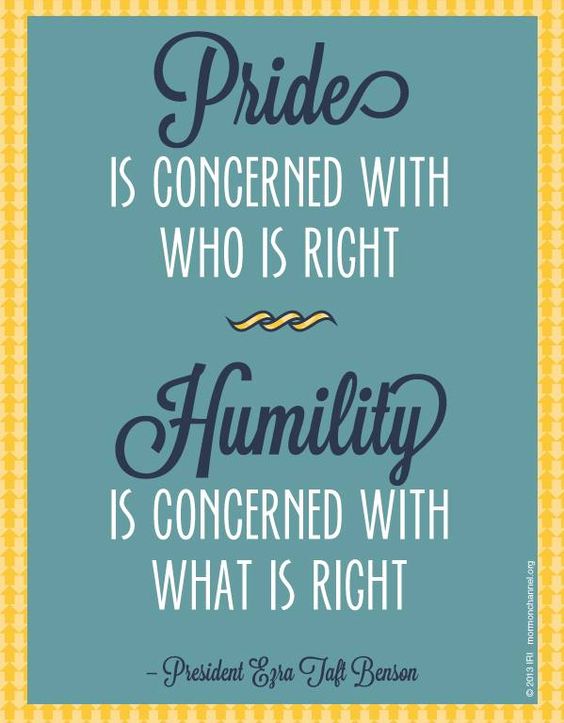
We need to be careful when it comes to selfishness, it does not belong in a marriage. President Ezra Taft Benson counseled, selfishness is one of the more common faces of pride. “How everything affects me” is the center of all that matters – self-conceit, self-pity, worldly self-fulfillment, self-gratification, and self-seeking (Benson).


The world teaches when you are married you things like “Defend yourself,” “You don’t have to put up with that,” and “Backing down is a sign of weakness.” When in truth, being a Christlike example and turning the other cheek is the way to live. This is not bowing down to your spouse, and your spouse is not bowing down to you either.

What I mean is learning about ourselves and each other in the marriage, and sometimes it is not very pleasant. Facing these challenges is exactly what is needed to grow and become more Christlike, what do we do when we face each other during conflict? Do we turn away from each other or do we turn toward each other?


If we go by the “world” we will turn away, that makes logical sense, right? After all, there is no foundation of faith, so we may as well look after number one. This is where Satan wins.  During the stress of marriage and parenthood our faults maybe begin to be show, we might be tempted to strike out and blame others – like our spouse or children – for these issues. Satan will laugh us into conflict and misunderstanding – unless we yield to the enticings of the Holy Spirit and put off the natural man (see Mosiah 3:19).

You might be asking yourself what it means to “put off the natural man” (Goddard 71). Basically it means to be humble. No, I am not saying you need to humble yourself to your spouse and always do what they say. But between the two of you, work together to keep respect, appreciation, and love for each other. There are enough pressures in the outside world without bringing them into your home.
If there is a time when problems arise and selfishness comes into play, think of the repentance that could take place with lives changed, marriages preserved, and homes strengthened, if pride did not keep us from confessing our sins and forsaking them (See D&C 58:43) (Benson).


With humility comes repentance. Humility opens us up to the experience of others and to the truth of Heaven. We must set aside our provincial view of the world (and of our spouses), and be open to our partner’s perspective. We must invite truth, the heavenly perspective (Goddard 71).

During this time we have to realize if we have invited this truth into our hearts, which we see not only are we probably annoyed with our spouse, we have probably annoyed our spouse as well. We can either leave things as they are, or we can repent and ask for forgiveness.


A good motto kept in our marriage is to “forgive and move on.” This sentiment is echoed in a talk given by Richard B. Miller at BYU in 2010, he gave this advice: 
If you are still upset after all of these months because your spouse didn’t take you to your favorite restaurant on your birthday, forget it. If your spouse continually doesn’t load the dishwasher correctly despite your best instructional techniques, leave it alone and move on. If your spouse spent the entire evening at his or her mission reunion speaking a language that you don’t understand, get over it. 
As President Packer said, “We call that forgiveness.” Our marital relationship is too important for us to clutter our minds and hearts with resentment that is created by dwelling on the faults and weaknesses of our spouse. We need to forgive and move on (Miller).
Remember, no one is perfect. We are put on this earth to learn and grow. We are teaching one another, we are teaching our children. Dr. John M. Gottman comments that wives complain men still aren’t doing their fair share of domestic chores and child care (Gottman 125). This makes me wonder how many of these wives yield control to their spouses, or better yet, how many of the spouses actually accept the influence of their wives and step in to help.


Gottman talks about husbands who are “emotionally intelligent,” describing them as having figured out how to keep that detailed map I blogged about before, keeping the admiration and fondness for her, and he communicates it by turning toward her in his daily actions. This not only benefits the spouse, but the children as well. Because he is so connected to his wife, she will come to him not only in troubled times, but in good times, and so will his children (124-125).

Why do I add this little tidbit? Because it reminds me of my own marriage and family. This is what I hope for all marriages. To have a marriage where you can turn to your spouse and know you can trust that person with your deepest, darkest secrets. To know that your children can feel comfortable calling either one of you on the telephone from anywhere in the world for advice. That person is your best friend and will be with you for eternity.


References:

Benson, E.T., (1989). Beware of pride. Ensign. https://www.lds.org/general-conference/1989/04/beware-of-pride?lang=eng
Book of Mormon
Godddard, H.W. (2007). Drawing heaven into our marriage: Powerful principles with eternal results. Fairfax, VA: Meridian Publishing
Gottman, J.M., Silver, N., (1999). The seven principles for making marriage work: A practical guide from the country’s foremost relationship expert. (2nd edition) New York: Harmony Books.
KJV Bible
Miller, R.B., (2011). Repentance and forgiveness in marriage. Ensign. https://www.lds.org/ensign/2011/09/repentance-and-forgiveness-in-marriage?lang=eng


Saturday, February 20, 2016

Turn Toward An Eternal Bond


We are taught an eternal perspective to marriage, in this I truly believe that Heavenly Father did not intend the husband-wife relationship to last only for this life. Adam and Eve were married by Heavenly Father before the Fall, and their actions in the garden did not invalidate their holy marriage. Death did not separate them, as they were reunited in the spirit world. Exaltation in the modern days is only available to husbands and wives, a man and a woman who love each other dearly and are worthy, in the Holy Temple. As I have said before, being married in the Holy Temple enters a couple into “a new and everlasting covenant of marriage” (Doctrine & Covenants 131-4).


With such a wonderful start to marriages, one would think that everything would be of the utmost perfection. Elder Robert D. Hales reminded us:

“An eternal bond doesn’t just happen as a result of sealing covenants we make in the temple. How we conduct ourselves in this life will determine what we will be in all the eternities to come. To receive the blessings of the sealing that our Heavenly Father has given to us, we have to keep the commandments and conduct ourselves in such a way that our families will want to live with us in the eternities. The family relationships we have here on this earth are important, but they are much more important for their effect on our families for generations in mortality and throughout all eternity” (Hales).

President Ezra Taft Benson taught us that “when we put God first, all other things fall into their proper place or drop out of our lives…We should put God ahead of everyone else in our lives” (Benson). What does this mean? It means what I have said previously, marriage is made up of little thorns that wheedle their way under a couple’s skin and cause irritation. You might find yourself grumbling about the way the toothpaste tube is used, the toilet paper roll is put on (does it really matter which way the paper faces?!), how your spouse tucks in their shirt, or any other miniscule irritation. Really, I am sure I can go on and on, but you have the picture by now. Once you get these things into your head, they transform from being small things into these enormous monstrosities that block out the wonderful person you married. These are the nitpicky things I referred to in my last blog post. 


Do not fret, these things can be overcome, and believe it or not, your significant other has probably done the same thing to you! Why does this happen, because Satan has seen what a wonderful relationship you have and has decided to dig a wedge in there. By keeping an eternal perspective on your marriage at all times, you can keep the adversary out and Heavenly Father in. I know, it is not all roses, and there will always be trials. Trials are for growth, they are not always bad, remember that.

So, back to the eternal perspective. H. Wallace Goddard has suggested that instead of judging our partner, we invite Christ to soften our hearts and fill us with goodness. No challenges or differences in marriage can thwart the work of god-given charity (Goddard 59-60). I find this to be true, as we turn toward our spouses with love and kindness, they too will do the same with us. Which brings me to the next topic, turning toward your spouse.

When we have issues as described above, our tendency is to turn away, walk away, or get defensive. Do not tell me that you have not done it, as I know I have at one time or another, no one is perfect. We’re not s’posed to be perfect! Okay, I have your attention again. Look here, Dr. John Gottman spends hours upon hours studying archives filled with endlessly dull scenes in which, for example, the husband looks out the picture window and says, “Wow, look at that boat,” and the wife peers over magazine and says, “Yeah, it looks like that big schooner we saw last summer, remember?” and the husband grunts (Gottman 87).

Why does he do this? Because he is looking for something in particular, he knows after years of study, that couples who engage in lots of interaction tend to remain happy. What is happening in that little back and forth over the newspaper and picture window is the couple is connecting – they are turning toward each other (87).


Oh, I know, how romantic, right? It is not always like it is in the movies, for that I am thankful. Because after nearly twenty-five years, my relationship with my husband has never been anything near a Hollywood movie scene. This is okay, because we are happily married and the best friends. In our marriage we make what Gottman calls “bids” for attention – now mind you I did not know this is what they were called and that we were doing it – in marriage, couples are always making “bids” for each other’s attention, affection, humor, or support. These can be as minor ask asking for a backrub or as significant as seeking help in carrying the burden when an aging parent is ill (88).

The partner responds to each bid either by turning toward the spouse or turning away. A tendency to turn toward your partner is the basis of trust, emotional connection, and passion. Now this may sound crazy, but Gottman even says that romance is strengthened in the supermarket aisle when your partner asks, “Are we out of butter?” and you answer, “I don’t know. Let me go get some just in case,” instead of shrugging apathetically (88). But I am telling you, it is not crazy, because this is exactly what my husband and I do and have done.


Every time a couple turns toward one another, they are building up trust with each other. When the day comes that an issue arises, the couple is less likely to teeter over into distrust and chronic negativity during those hard times (89). But marriage isn’t just about raising kids and splitting chores… (261).

Which, I can definitely attest! There is so much more to marriage, it is about making life with each other, a special bond which no one else understands. Gottman could have been talking about my marriage when he said this “Part of marriage’s culture, the story they tell themselves, about themselves, is what a great team they make, how feisty they are, how they thumbed their noses at all the naysayers and succeeded against the odds” (261). Did this mean that my husband shared the same dream? No, it just means that we found ways to turn toward each other, or as Gottman puts it to “mesh” (261).


We realized that even though our backgrounds growing up were quite different, we still held similar beliefs in raising children. This helped us to go forward and grow as a couple and as a family. The more shared meaning you can find, the deeper, richer, and more rewarding your relationship will be. Along the way you’ll also be strengthening your marital friendship. This in turn will make it even easier to cope with any conflicts that crop up (263).

Marriages are strengthened when we incorporate the teachings and principles of the gospel of Jesus Christ in our lives and recognize that His mission is essential to our having an eternal companionship. Emotional and physical contact between husband and wife enriches that love, as a couple keeps the covenants and ordinances they have made in the Holy Temple before God, their relationship will continue through eternity.


References:

Benson, Ezra T. “The Great Commandment – Love the Lord,” Ensign, May 1988, online, https://www.lds.org/ensign/1988/05/the-great-commandment-love-the-lord?lang=eng

Doctrine & Covenants

Godddard, H.W. (2007). Drawing heaven into our marriage: Powerful principles with eternal results. Fairfax, VA: Meridian Publishing

Gottman, J.M., Silver, N., (1999). The seven principles for making marriage work: A practical guide from the country’s foremost relationship expert. (2nd edition) New York: Harmony Books.


Hales, Robert D. “The Eternal Family,” Ensign, November 1996, p. 65

Saturday, February 13, 2016

Mapping Your Marriage


Do you realize that your marriage is a living organism? Take a step back and look at the effort it takes to keep a happy relationship intact. In past blogs I have talked about being best friends with your partner and the importance of getting to know each other. Getting to know one another does not stop when you marry. People are still growing and evolving throughout life. Make sure that as each of you grow, ensure that you are aware of the joys, likes, dislikes, fears and stresses that are happening to the other.


Love Maps


When emotionally intelligent couples are intimately familiar with each other’s world, Dr. Paul Gottman refers to this as a love map. The couple remembers the major events in each other’s history, and they keep updating their information as the facts and feelings of their spouse’s world change (Gottman 54). Having this type of knowledge strengthens a marriage. There will be times, as mentioned before, when feelings will be hurt or something will seem a bit out of whack. The only way to get to the bottom of the issue is to know our spouse. 

Part of getting to the issue is listening to our spouse. We must open our ears and our hearts, not just pay lip service. How many times do we find ourselves just saying, “Uh huh,” when our spouse is earnestly spilling their day out to us? If we listen carefully and learn humbly about our partners’ points of view, we will be enlarged and enriched (Goddard 43). When asking our partner about their day, be ready to listen, and really absorb what they are saying. This may be the most important clue as to how they are growing spiritually, emotionally, mentally.


Using this knowledge goes perfectly into the idea of Gottman’s love map. Couples who have detailed love maps of each other’s world are far better prepared to cope with stressful events and conflict. Surprisingly, Gottman points out that a major source of marital dissatisfaction and divorce is having a child (Gottman 54). This was news to me, as I had always thought that adding a special little spirit was a wonderful decision, evidently this is not always the case.

Some marriages do not thrive so well when it comes to adding a bundle of joy to the mix. This is because these couples are not acutely aware of each other in the first place, their love map is not in place and they “lost their way”. If a couple keeps up to date with each other and are already aware of what each other is feeling and thinking, they will not be thrown off course (55). Of course, having a child is just one example, there are many other events in life which can throw a couple off course. Ensuring that you know each other is the major key in keeping on a steady course to eternal happiness.


Remember to keep updating your love map on a regular basis. The more you know about each other’s inner world, the more profound and rewarding your relationship will be (62). I have spent the past twenty-four plus years getting to know my husband, every day I learn something new about him. I am blessed for this opportunity, we are growing and learning spiritually and emotionally together – our love map. Interestingly, we did not even know we were following this guideline all along.

Happily married couples don’t “just” know each other. They build on and enhance this knowledge in many important ways. For starters, they use their love maps to express not only their understanding of each other but their fondness and admiration as well (66).


Expressions of Love


Over the years my husband and I have never held back when it came to expressing our feelings for one another. We have always told each other “I love you” or “You look handsome” or “You look gorgeous,” well you get the picture. Fondness and admiration are two of the most crucial elements in a rewarding and long-lasting relationship according to Dr. Gottman (69).  Sometimes a partner may have some issues that really drive us nuts, nobody is perfect, we are not meant to be. Interestingly, this has been addressed by the Prophets and Apostles, as noted in this quote from Elder Joe J. Christensen:

“Avoid ‘ceaseless pinpricking.’ Don’t be too critical of each other’s faults. Recognize that none of us is perfect. We all have a long way to go to become as Christlike as our leaders have urged us to become. “‘Ceaseless pinpricking,’ as President Spencer W. Kimball called it, can deflate almost any marriage. … Generally each of us is painfully aware of our weaknesses, and we don’t need frequent reminders. Few people have ever changed for the better as a result of constant criticism or nagging. If we are not careful, some of what we offer as constructive criticism is actually destructive” (Christensen 19).


When a relationship comes to the point where there is constant nagging, take a step back and think about what brought the two of you together. Not what began the argument, but think about your wedding or when you met, now what were you fighting about again?! When my husband and I argue, the arguments rarely last more than a half hour at the most. We usually end up making faces at each other, giggling, or saying something silly to lighten the mood. The issue is resolved and the day moves on. Never go to bed angry, always kiss each other goodnight. I like what Gordon B. Hinckley had to say about marriage:

“Companionship in marriage is prone to become commonplace and even dull. I know of no more certain way to keep it on a lofty and inspiring plane than for a man occasionally to reflect upon the fact that the helpmeet who stands at his side is a daughter of God, engaged with [God] in the great creative process of bringing to pass His eternal purposes. I know of no more effective way for a woman to keep ever radiant the love for her husband than for her to look for and emphasize the godly qualities that are a part of every son of our Father and that can be evoked when there is respect and admiration and encouragement. The very processes of such actions will cultivate a constantly rewarding appreciation for one another” (Hinckley 24).

Being positive is essential in a good relationship, I am a genuinely positive person for many reasons, which I will not delve into I have had to be. Having this positive view of your spouse and your marriage is a powerful buffer when bad times hit. Having a reserve of good feelings will prevent a cataclysm of thoughts about separation and divorce each time an argument arises (Gottman 71).


Heavenly Father promises, “Give, and it shall be given unto you; good measure, pressed down, and shaken together, and running over, shall men give into your bosom. For with the same measure that ye mete withal it shall be measured to you again” (Luke 6:38).

One last thought I’d like to leave with this post is to cherish your spouse. Cherishing is a habit of mind in which, when you are separated during the course of the day, you maximize thoughts of your partner’s positive qualities and minimize thoughts of negative ones (78). By doing this you will have the opportunity to realize the worth of your spouse, and when you reunite at the end of the day, you will appreciate those blessings.


References:
Christensen, J.J., Marriage and Family Relations Participant’s Study Guide. The Church of Jesus Christ of Latter-day Saints

Godddard, H.W. (2007). Drawing heaven into our marriage: Powerful principles with eternal results. Fairfax, VA: Meridian Publishing

Gottman, J.M., Silver, N., (1999). The seven principles for making marriage work: A practical guide from the country’s foremost relationship expert. (2nd edition) New York: Harmony Books.

Hinckley, G. B., Marriage and Family Relations Participant’s Study Guide. The Church of Jesus Christ of Latter-day Saints

The Holy Bible, (1979). Church of Jesus Christ of Latter-day Saints. Salt Lake City, UT.


Saturday, February 6, 2016

Eternal Friendship


You know when you meet someone and you just know that is THE one person you will be with forever? Yeah, me too. Although I don’t think he knew it. My two year old did though, she was already calling him “daddy” before he was ready for that. I had to laugh the first time he came back from a month long training mission (he was in the Army) and she said “DADDY!” His response, “No, just John!” and gave her a big hug. She knew better, and in his heart, so did he. Twenty-four years later I am still married to my best friend.


How can this be done? Keep a positive, happy, relationship. When a couple does have arguments, do not let them last long and talk them out. As Dr. John Gottman said “Happily married couples aren’t smarter, richer or more psychologically astute than others. But in their day to day lives they have hit upon a dynamic that keeps their negative thoughts and feelings about each other (which all couples have) from overwhelming their positive ones. Rather than creating a climate of disagreement and resistance, they embrace each other’s needs… This positive attitude not only allows them to maintain but also to increase the sense of romance, play fun, adventure and learning together that are at the heart of any long-lasting love affair”(4).


Gottman also said that “at the heart of the Seven Principles approach is the simple truth that happy marriages are based on a deep friendship” (21). Couples who take the time to get to know each other before marriage tend to stay together. I am not talking intimately, I am talking about their likes and their dislikes. What movies they like, what foods do they eat, do they like cats or dogs. Are they allergic to cats or dogs?! Is there a certain trait that really bugs you that you did not realize they had before? These are things you need to know BEFORE you marry. If they bother you now, will you be able to live with them for eternity? Gottman uses an example of a couple hosting a party: 

Nathaniel calls, “Where are the napkins?” and Olivia yells back edgily, “They’re in the cupboard?” Because their marriage is founded on a firm friendship, he shrugs off her tone of voice and focuses instead on the information Olivia has given him – the napkins are in the cupboard (22). 

The point here is because their friendship is so strong, Nathaniel knows that Olivia gets a little stressed when she feels crunched on time. This is what marriage is all about, knowing how your partner feels and not over reacting when they get a little snippy.


I am not saying that marriage is always sunshine and roses. H. Wallace Goddard put it bluntly when he said “God did not design marriage as a retirement village where we sunbathe, work the buffet, and play golf” (16). It takes the help of the gospel to keep a good marriage in proper order. Knowing that “Marriage between man and woman is essential to His eternal plan” (Proclamation) will help to maintain the couple on the right course. We need to remember that if we make a mistake, have a squabble, spill a little milk, there is forgiveness to be had. Do not be too quick to judge. As H. Wallace Goddard reminds us, “How vital mercy is in family life! We forgive our parents of their flaws and limited knowledge. We forgive our partners for being human. We forgive our children for being children grace and mercy are at the heart of love family life” (32).


I will leave you with this last reminder from Elder Joseph B. Wirthlin, “True love lasts forever. It is eternally patient and forgiving. It believes, hopes, and endures all things. That is the love our Heavenly Father bears for us. We all yearn to experience love like this. Even when we make mistakes, we hope others will love us in spite of our shortcomings—even if we don’t deserve it” (Wirthlin).


References:

Goddard, H. W. (2007). Drawing heaven into your marriage: Powerful principles with eternal results. Fairfax, VA: Meridian Publishing.

Gottman, J.M., Silver, N., (1999). The seven principles for making marriage work: A practical guide from the country’s foremost relationship expert. (2nd edition) New York: Harmony Books.

The First Presidency and the Council of the Twelve Apostles (1995) The Family: a proclamation to the world, retrieved from: https://www.lds.org/topics/family-proclamation?lang=eng


Wirthlin, J.B., (2007). The great commandment. Ensign, retrieved from: https://www.lds.org/general-conference/2007/10/the-great-commandment?lang=eng